






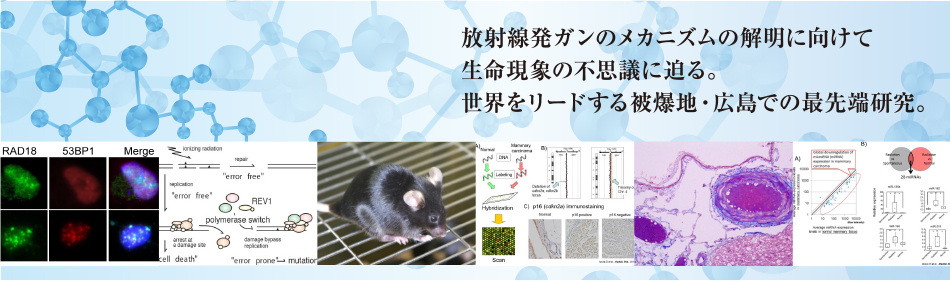






Carcinogenesis, particularly radiation-induced carcinogenesis, is strongly influenced by an individual’s genetic background. Factors that have traditionally been described in vague terms such as “cancer predisposition” or “cancer-prone families” are now recognized as one of the most critical research topics in contemporary cancer biology. In our research field, cancer is viewed as a polygenic disease embedded within the host’s genetic background, and we aim to elucidate the molecular mechanisms of carcinogenesis as a dynamic process that emerges through diverse cellular and tissue-level responses.
Our specific research objectives are to clarify the molecular mechanisms of carcinogenesis induced by genome-damaging agents such as radiation and chemical substances, and to translate these findings into medical applications and cancer prevention strategies. As a core research strategy, we employ state-of-the-art technologies to analyze DNA damage responses and repair pathways in order to elucidate the relationship between genome instability induced by genotoxic agents and carcinogenesis. Building on these fundamental studies, we seek to uncover the molecular mechanisms of carcinogenesis at the organismal level using rigorously controlled experimental systems, including transgenic mice, gene knockout mice, and model rodents with unique genetic backgrounds. Through these approaches, we aim to define the molecular processes by which genome damage caused by radiation and other insults leads to DNA repair, mutation accumulation, and ultimately carcinogenesis through disruption of higher-order biological regulatory systems, and to apply our findings to cancer diagnosis, therapy, and prevention.